Keeps your natural tooth
Nothing replaces a tooth as well as the tooth itself, especially for chewing.
A root canal treats infection inside the tooth so you can keep it. With modern anaesthetic, it feels much like getting a filling.
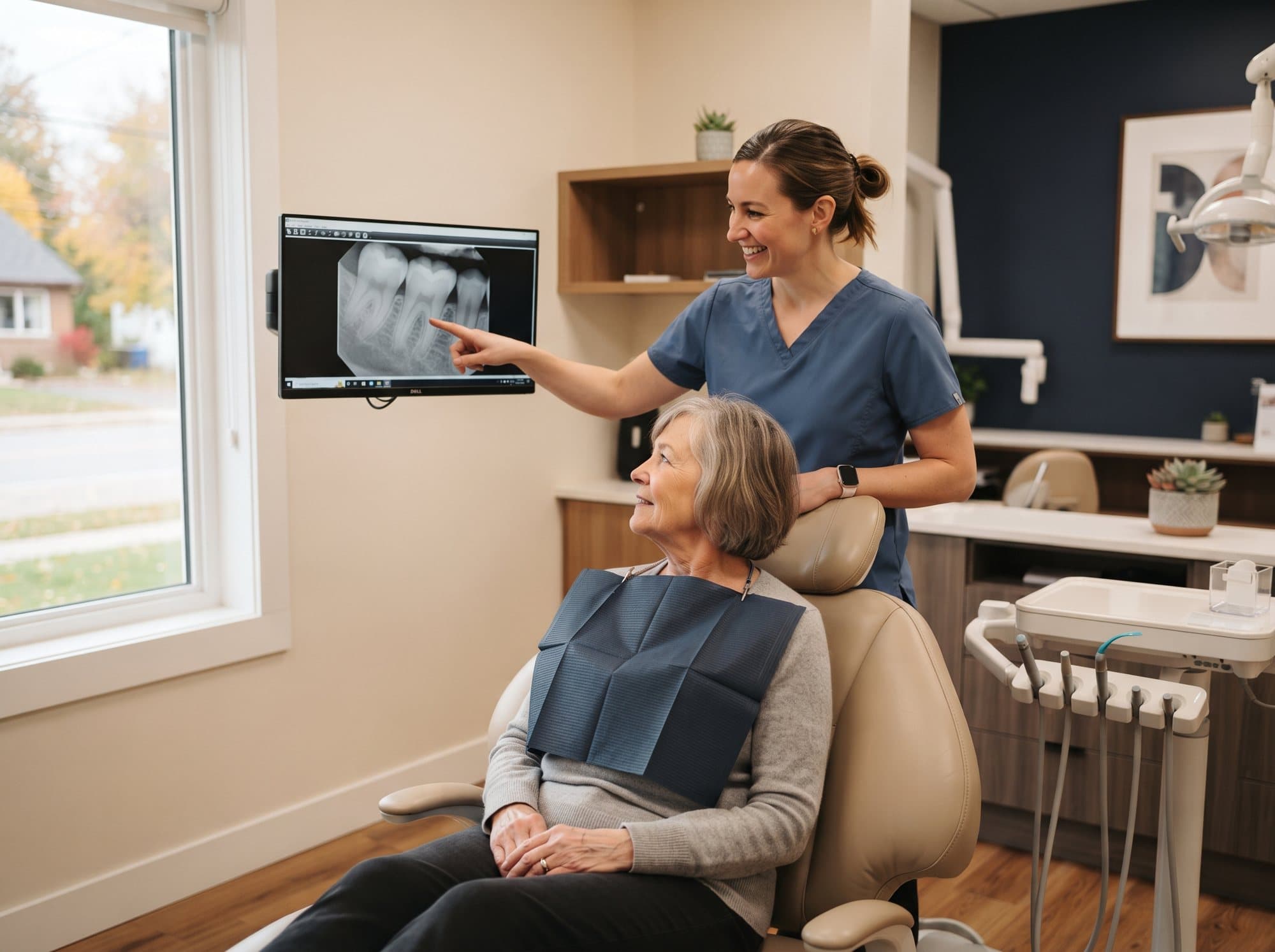
Inside each tooth is a small space filled with nerve and blood vessels, called the pulp. When deep decay, a crack or a knock lets bacteria in, the pulp becomes inflamed or infected. That's what causes the throbbing toothache, sensitivity to heat, or a pimple on the gum. Left alone, it can turn into an abscess and eventually cost you the tooth.
Root canal therapy removes the infected pulp, cleans and shapes the canals inside the root, and seals them. The outside of the tooth stays, so you keep your own tooth in your own bite. Dr. Parminder Singh provides root canal therapy at our Owen Sound office, so most patients don't need to be referred out of town.
The reputation root canals have for being painful comes from the infection, not the treatment. The procedure is done under local anaesthetic, and for most people it's the thing that finally makes the pain stop.
Nothing replaces a tooth as well as the tooth itself, especially for chewing.
Removing the infected pulp usually brings relief within a day or two.
Dr. Parminder Singh treats root canals right here in Owen Sound, without a trip to a city specialist.
Keeping the tooth stops the others from drifting and keeps bone in the jaw.
An exam and X-ray confirm the pulp is the problem and show the shape of the roots.
Once the tooth is fully numb, a small opening is made through the top to reach the canals.
The canals are cleaned, disinfected and filled with a rubber-like material. Sometimes this takes two visits if infection needs to settle.
A root-canalled tooth is more brittle, so back teeth almost always need a crown afterwards to prevent cracking.
Expect the tooth to be tender for a few days, especially when biting. Regular pain relievers handle it for most people. Until the final crown is placed, chew on the other side, since the tooth is more fragile in the meantime.
Root canal therapy is commonly covered by the Canadian Dental Care Plan, ODSP, Ontario Works and most private plans. The crown afterwards is billed separately and may need pre-approval; we'll sort that out before you're in the chair.
If your question isn't here, call us. A real person picks up during office hours.
The procedure itself shouldn't hurt; the tooth is thoroughly frozen first. Most patients say it felt no different from a large filling, and the toothache they came in with is gone afterwards.
Often one, sometimes two if the infection is severe. The crown is usually a separate visit or two after that.
Extraction is quicker, but a missing tooth needs replacing with an implant, bridge or partial denture to stop the others from shifting. Saving the tooth is usually the simpler path in the long run.
For molars and premolars, yes in almost all cases. Without one, the tooth is much more likely to crack and be lost.
With a crown and normal care, a root-canalled tooth can last as long as any other tooth.
Send a request and Sandy or Shantell will call you back during office hours to find a time that fits. Emergencies: please phone us directly.