Frozen properly
We don't start until you're fully numb, and we check as we go.
Extractions and minor oral surgery are done in our Owen Sound office under local anaesthetic, with time taken to explain what happens next.
Sometimes a tooth can't be saved: decay has gone too deep, a crack runs below the gum, gum disease has loosened it, or a wisdom tooth is impacted and causing trouble. Removing it is a routine procedure here, and Dr. Parminder Singh has a particular interest in surgical dentistry.
Most extractions are simple: the tooth is loosened and lifted out under local anaesthetic. Some, including many wisdom teeth, are surgical, meaning a small incision in the gum and sometimes dividing the tooth into pieces to remove it gently. Either way, you're fully frozen, and most patients say the anticipation was worse than the appointment.
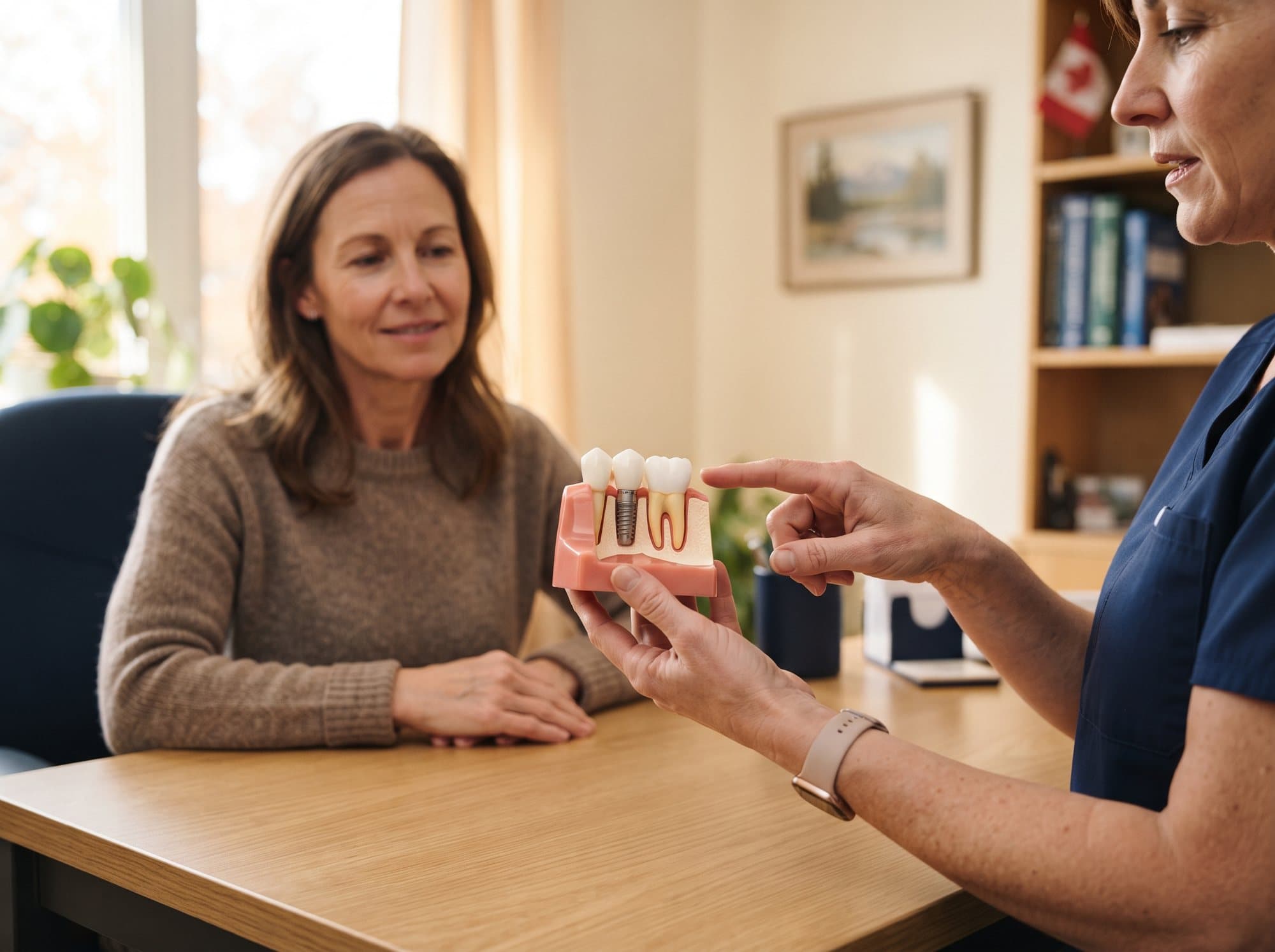
If you plan to replace the tooth with an implant later, we can place grafting material into the socket at the same visit. This is called socket preservation, and it keeps the bone from shrinking so an implant is easier down the road. We use local anaesthetic only; if you need sedation or have a complex impaction, we'll refer you to an oral surgeon.
We don't start until you're fully numb, and we check as we go.
Careful, patient removal means less trauma and a faster recovery.
Grafting at the time of extraction keeps future implant options open.
You leave with clear instructions and a number to call.
An X-ray shows the root shape and nearby nerves and sinuses, and we talk through options for replacing the tooth.
Local freezing. You'll feel pressure during the procedure but not pain.
Simple or surgical, depending on the tooth. Wisdom teeth may take a little longer.
Socket preservation material is placed, and dissolving stitches close the gum where required.
Bite on gauze, go home, rest. Most people are back to normal in a few days.
For the first 24 hours: bite on gauze until bleeding stops, avoid rinsing, spitting, straws and smoking, and rest with your head up. From day two, rinse gently with warm salt water after meals. Take pain relief before the freezing wears off rather than waiting. Swelling peaks around day two or three and then eases.
Call us if pain gets worse after day three rather than better, if bleeding won't stop, or if you notice a bad taste and an empty-looking socket; that can be a dry socket, which we can treat easily. After-hours help is available Monday to Thursday at (519) 371-9415.
If your question isn't here, call us. A real person picks up during office hours.
Not with proper freezing. You'll feel pushing and pressure, which is normal, but if you feel sharp pain we stop and add more anaesthetic.
We use local anaesthetic only. If you'd need sedation or a general anaesthetic, we'll refer you to an oral surgeon and coordinate your care.
No. If they've come through fully, are easy to clean and aren't causing problems, they can stay. Impacted, partially erupted or repeatedly infected ones are usually better removed.
A simple extraction: a day or two of tenderness. Surgical or wisdom teeth: a few days of swelling and soreness, with most people back to work or school within two to three days.
Usually, especially for back teeth, since neighbours drift and the opposing tooth over-erupts. An implant, bridge or partial denture are the options, and we'll discuss them before the extraction.
Send a request and Sandy or Shantell will call you back during office hours to find a time that fits. Emergencies: please phone us directly.